
2025 Sustainability Year in Review
Happy New Year! Holy, what an absolute year 2025 was. I usually try to start these videos on some sort of positive note but if I am honest, it seems like 2025 has kind of left everyone a bit battered. And, unfortunately, sustainability was one of the prime targets. Having said that, I think it is important to remember that progress is not a straight line. We may be in a challenging moment but that shouldn’t negate the amazing progress that has been made over the last few decades. We have global environmental agreements for nature and climate, the energy transition is well underway and renewables are more attractive than fossil fuels in many markets, sustainable investing now makes up a quarter of the overall financial market, we have made great strides in reducing child and maternal mortality and have greatly reduced deaths related to TB, malaria, and AIDS, connectivity has improved around the world, more children are in school, I could go on but you get the picture. So while this year’s video is not going to be too rosy, I do want to remind everyone… and myself… that change is possible and we have to keep pushing.
Anniversaries Galore
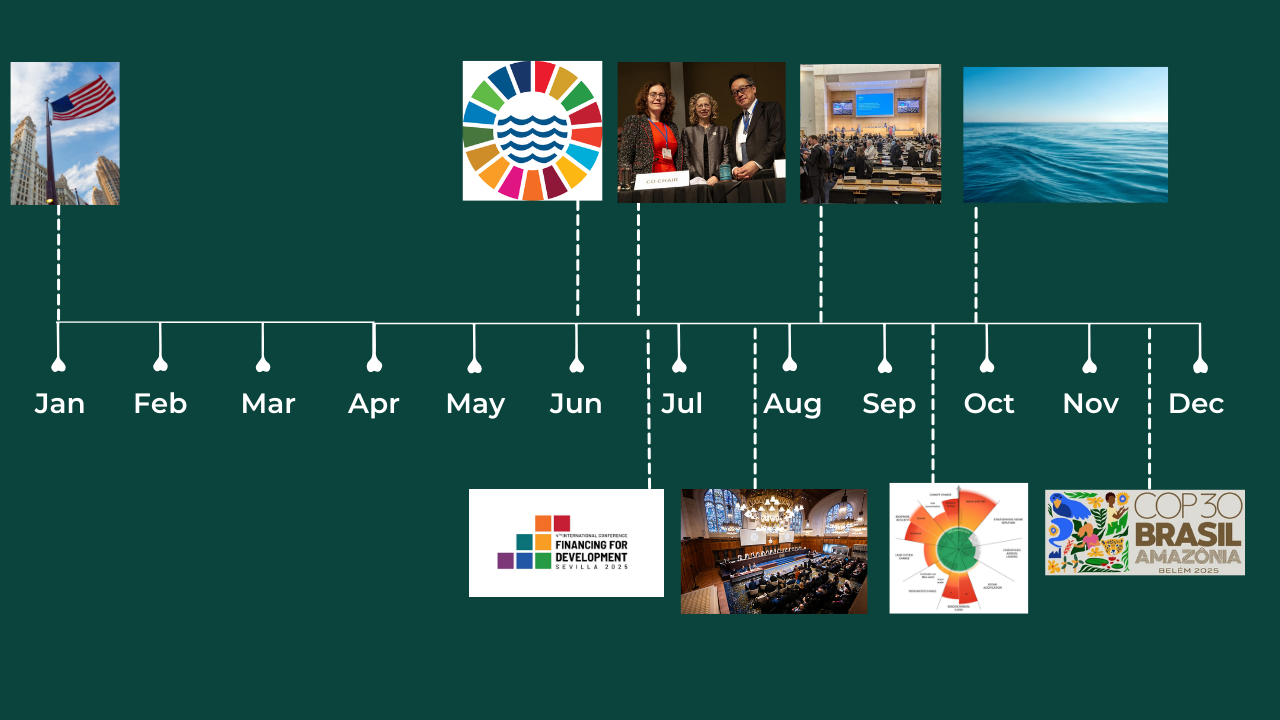
2025 marked the 80th birthday and the UN and the 10 year anniversary of several large global sustainability agreements including the 2030 Agenda for Sustainable Development and its 17 Sustainable Development Goals, the Addis Ababa Action Agenda for financing, the Paris Agreement on climate change, and the Sendai Framework for Disaster Risk Reduction (DRR). As is always the case, anniversaries prompt reflection on how we are doing and it is kind of a mixed bag in terms of achievements. When it comes to the SDGs, only 35% of 169 targets are on track or making modest gains. Nearly half are progressing too slowly, and 18% are actually regressing (United Nations). And for the Paris Agreement, while we are not achieving progress fast enough, but there has been some notable improvements. Since the agreement was reached, we have completely changed the trajectory we were heading for. In 2015, we were projected to have 4.5 degrees of warming but we are now looking at projections more in the range of 2.3 and 2.9 degrees. While this is far from 1.5 or 2 degrees it does show action is happening (WRI). In addition, clean tech has grown considerably. Electric vehicles grew from less than 1% to 22% of new car sales (WRI). Renewable energy is significantly cheaper as well. In 2025, the International Renewable Energy Agency reported that 91% of renewables projects are now cheaper than fossil fuel projects (IRENA). In addition, solar and wind’s share of total electricity generation have tripled since 2015 (WRI). So, while there were some setbacks this year, we are seeing promising signs that the transition is well underway. Let’s have a look at the calendar and moments that happened throughout the year.
January
In January, Donald Trump became the President of the US and this immediately led to turmoil in the multilateral system and for sustainability generally. He publicly pushed back against the UN withdrawing from the Paris Agreement, the World Health Organization, UNHCR, and UNESCO, he massively cut global aid, eliminating 83% of USAID programs, and he directly went after programs that were meant to promote diversity, equity and inclusion or DEI as you have probably heard it referred to. These drastic measures plunged the global multilateral and humanitarian systems into chaos as many organizations were forced to make immediate, drastic cuts.
June
The first half of the year, therefore, was a lot of scrambling by UN entities, NGOs, and developing country governments. There was a global nutrition conference in Paris in March but other than that, there was not much of note until the summer. In June, two notable multilateral sustainability conferences took place - the third UN Ocean Conference in Nice, France and the Fourth International Conference on Financing for Development (FFD4) in Seville, Spain. The Ocean Conference resulted in the Nice Ocean Action Plan, a two-part framework that has a political declaration and over 800 voluntary commitments by governments, scientists, UN agencies, and civil society. It also resulted in 19 new countries signing onto the High Seas Treaty… I will come back to that later. There was a lot of hype around the FFD4 but to be a completely blunt and a little cynical, the outcome was just a long UN-type document with a lot of talk about mobilizing resources domestically, encouraging private sector, and reforming global aid and debt architecture. As an external observer, it doesn’t really seem like much is moving on those priorities given the current climate but I guess let’s wait and see.
Another interesting thing that happened in June was the establishment of a new Intergovernmental Science-Policy Panel on Chemicals, Waste and Pollution (UNEP) at a UNEP meeting in Uruguay. You may be familiar with this type of organization as there are similar structures for both climate and biodiversity. For climate it is called the Intergovernmental Panel on Climate Change and for nature the Intergovernmental Science-Policy Platform on Biodiversity and Ecosystem Services. It was only logical that another be formed to reflect the triple planetary crisis that UNEP speaks about - climate change, nature loss, and pollution. These bodies are made up of global scientists who work together to provide independent, policy-relevant scientific advice. In 2025 the panel was struck and the initial work programme and priorities will be set in 2026.
July
In July, the International Court of Justice made a ruling declaring climate change an urgent, existential threat, and affirming that all states have legal obligations under international law to protect the climate and prevent harm, meaning inaction could create legal liability. (House of Commons Library) While this is a fantastic symbolic victory on a normative level, the sad reality is that international law is not particularly enforceable. However, the ruling does give a legal basis for reparations, guarantees of non-repetition, and cessation of the wrongful act or acts so let’s take the wins where we can get them. (SEI)
August
In August, states entered another round of negotiation to limit global plastic pollution. This is something I covered last year but to give a quick summary: these negotiations began in 2022 and have had a series of negotiations, the most recent in Busan, Korea failed miserably so a negotiation was scheduled for summer in Geneva, Switzerland. Unfortunately, Geneva negotiations did not result in anything substantive and an agreement was once again not reached. The reasons for failure were similar to those in Korea, namely a clash between a high ambition coalition that wanted production caps and to address the entire life cycle of plastic, and oil producing nations who wanted much less stringent rules and voluntary waste management plans (Kimo). There was a deadlock and ultimately any agreement that could’ve been reached would have been very watered down so it was abandoned for now. There are currently no plans for another round of negotiations.
September
September brought a mix of good and bad news for the ocean. Let’s start with the bad news so we can end on a good note. At the end of September, the Stockholm Resilience Centre announced that we have officially passed the 7th planetary boundary on ocean acidification (SRI). For those of you who are not familiar with the planetary boundaries they are 9 environmental limits that constitute a safe operating space for the planet, they include things like changes to land and fresh water, CO2 concentrations, and biosphere integrity. I will leave a link to a document in the blog post if you want to learn more, and possibly do a video in the future, but the thing to know is that this is bad news, we are pushing our environment’s limits to the brink.
But moving to the good news, in September two separate agreements related to the ocean came into effect. The High Seas Treaty reached the 60 ratifications required to trigger its entry into force 120 days later, on 17 January 2026 (IISD). The treaty allows governments to coordinate international activities related to conservation of the ocean that is outside of individual country’s jurisdiction and should go a long way in protecting marine biodiversity (WRI). A second agreement on the oceans at the World Trade Organization, aimed at managing fishery subsidies and preventing overfishing was adopted by two thirds of the WTO membership and came into force. (WTO)
November
November is always climate COP time, and this year COP30 symbolically took place in the centre of the Amazonian rainforest in Belem Brazil. The outcomes of the gathering were a bit of a mix as per usual. Some wins included deeper participation from indigenous communities, a tripling of adaptation finance, a new fund for tropical forest conservation, and a range of voluntary initiatives announced by countries, cities, and companies. (WRI) The text adopted by countries called for mobilizing at least $1.3 trillion per year by 2035 for climate action, launched two major initiatives to help countries deliver on their national climate action plans, and for the first time, acknowledged the need to tackle climate disinformation. (UN) But the reality check is strong, it was widely reported in 2025 that the world is now on track to breach 1.5 degrees C of warming by 2030. In addition, 119 countries representing 75% of emissions resubmitted their NDCs or emission reduction commitments and together they only deliver less than 15% of the emissions reductions required for 1.5 degrees C putting us on course for 2.3-2.8 degrees C of warming. (WRI)
Keep Learning
Here are a few great resources for further reading and learning: